What are Soil Microbes & Why They Matter?

Soil microbes are tiny living organisms in the soil that you cannot see with your eyes — but they are doing more work beneath your feet than most factories do above ground.

If soil were a city, microbes would be the engineers, delivery drivers, recyclers, doctors, construction workers, and security guards all at the same time.

And without them?

The city collapses.

Whether you’re a commercial farmer, smallholder grower, regenerative agriculture advocate, or simply someone who cares about healthy soil and sustainable food production — understanding soil microbes is one of the most important steps toward improving crop yields naturally and building resilient farming systems.

Let’s break it down simply, clearly, and even a little humorously.

What Are Soil Microbes? (Explained So Simply a 5-Year-Old Would Get It)

Imagine the soil like a giant underground playground. Now imagine billions and billions of tiny living creatures playing there.

Those tiny creatures are soil microbes.

They are microscopic living organisms that live in soil. You cannot see them without a microscope, but they are very alive and very busy.

The Main Types of Soil Microbes

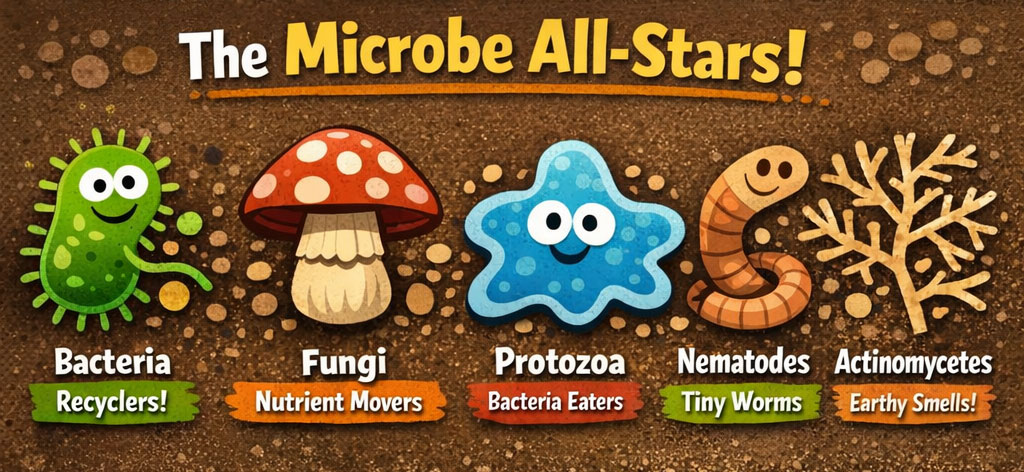
There are several key groups of soil microorganisms:
Browse MIcrobes Library

1. Bacteria

Tiny single-celled organisms. They are the recyclers and nutrient converters of the soil world.

2. Fungi

Think of them like underground internet cables. They connect plant roots and transport nutrients and water.

3. Protozoa

These are microbial predators. They eat bacteria and release nutrients in plant-available form.

4. Nematodes

Microscopic worms that help regulate the soil food web.

5. Actinomycetes

They give healthy soil that rich “earthy” smell after rain. They help break down tough organic matter.

Together, these microbes form what scientists call the Soil Food Web — a living network of organisms working together to create fertile, healthy soil.
Microbes All Stars What are Microbes

Why Soil Microbes Matter (More Than You Think)

If soil microbes disappeared tomorrow, modern agriculture would struggle within weeks.

Here’s why they matter:


1. Soil Microbes Make Nutrients Available to Plants

Plants cannot “eat” raw nutrients straight from the soil.

They rely on microbes to:

  • Convert nitrogen into plant-usable forms
  • Unlock phosphorus bound in soil
  • Break down organic matter into bioavailable nutrients
  • Chelate micronutrients like zinc and iron

Without microbes, nutrients remain locked up.

It’s like having a pantry full of food but no one to cook it.


2. They Improve Soil Structure Naturally

Healthy soil is not hard like brick or dusty like powder.

It should be crumbly, aerated, and sponge-like.

Soil microbes:

  • Produce sticky substances that bind soil particles together
  • Create soil aggregates
  • Improve water infiltration
  • Reduce compaction

Fungal hyphae (tiny fungal threads) act like underground stitching, holding soil together.

Better soil structure means:

  • Better root growth
  • Better drainage
  • Better drought resistance
  • Less erosion


3. Soil Microbes Increase Crop Yields Naturally

Farmers focused on sustainable agriculture and regenerative farming increasingly use microbial soil solutions because:

  • Microbes improve nutrient uptake efficiency
  • Roots grow deeper and stronger
  • Plants experience reduced stress
  • Crops show improved uniformity

Healthy microbial activity can reduce dependence on synthetic fertilisers over time — lowering input costs while maintaining productivity.


4. They Help Protect Plants from Disease

This one surprises many people.

Healthy soil microbes act like a natural immune system.

Beneficial microbes:

  • Outcompete harmful pathogens
  • Produce natural antibiotics
  • Create protective biofilms around roots
  • Trigger plant immune responses

When soils are biologically alive, harmful organisms struggle to dominate.

Dead soils, on the other hand, invite disease pressure.


5. They Help Soil Hold Water (Critical in South Africa & Drought Regions)

In regions like KwaZulu-Natal and other drought-prone areas, water retention is everything.

Microbial-rich soil:

  • Increases organic matter
  • Improves sponge-like structure
  • Enhances moisture holding capacity
  • Reduces runoff

That means less irrigation and more resilient crops during dry periods.

What Happens When Soil Microbes Are Destroyed?

Modern agricultural practices can unintentionally reduce microbial life.

These include:

  • Overuse of chemical fertilisers
  • Heavy pesticide use
  • Deep tillage
  • Soil compaction
  • Lack of organic matter

When microbial populations drop:

  • Nutrient cycling slows
  • Soil structure deteriorates
  • Plant stress increases
  • Fertiliser dependency rises

It becomes a cycle of “apply more to fix less.”


The Soil Food Web – Nature’s Underground Economy

Think of soil like a bustling underground economy.

Here’s how it works:

  1. Plants produce sugars through photosynthesis.
  2. They send some of these sugars into the soil through their roots.
  3. Microbes eat these sugars.
  4. In exchange, microbes deliver nutrients back to the plant.

It’s a trade agreement that’s been working for millions of years.

Plants literally “hire” microbes to feed them.

If that doesn’t change how you look at soil, nothing will.


Soil Microbes & Regenerative Agriculture

Regenerative farming practices focus heavily on building soil biology.

These include:

  • Cover cropping
  • Reduced tillage
  • Compost application
  • Microbial inoculants
  • Rotational grazing

By improving soil microbial diversity, farmers can:

  • Improve long-term soil fertility
  • Increase carbon sequestration
  • Build climate resilience
  • Reduce synthetic input reliance

This is why soil biology is becoming central to sustainable agriculture worldwide.


Soil Microbes and Carbon Sequestration

One of the most exciting aspects of soil microbes is their role in carbon storage.

Microbes:

  • Convert plant residues into stable organic carbon
  • Build humus
  • Lock carbon into soil aggregates

Healthy soil can store significant amounts of atmospheric carbon.

That means soil microbes are not just helping farmers — they are helping the planet.


How Do You Know If Your Soil Has Healthy Microbes?

Here are signs of biologically active soil:

  • Rich earthy smell
  • Presence of earthworms
  • Good root development
  • Crumbly texture
  • Good water infiltration
  • Strong plant resilience

Lab soil biology tests can also measure microbial biomass and diversity.


How to Increase Soil Microbial Life Naturally

If you want to boost soil microbes:

Add Organic Matter

Compost, manure, plant residues.

H3: Reduce Chemical Disturbance

Minimise excessive fertiliser and pesticide use.

Avoid Over-Tilling

Tillage disrupts fungal networks.

Use Microbial Inoculants

Biological soil amendments can introduce beneficial microbes back into depleted soils.

Keep Living Roots in the Soil

Cover crops feed microbes year-round.


Soil Microbes in Vegetable, Fruit & Livestock Farming

Soil microbes benefit all farming systems:

Vegetable Farming

  • Improved nutrient density
  • Stronger root systems
  • Reduced disease pressure

Fruit Orchards

  • Enhanced nutrient uptake
  • Improved flowering and fruit quality
  • Increased soil longevity

Pasture & Livestock Farming

  • Healthier pasture growth
  • Improved soil carbon levels
  • Better forage resilience

Healthy soil = healthy plants = healthy animals = healthy food.


The Future of Farming Is Biological

As fertiliser costs rise and climate conditions become more unpredictable, farmers are turning toward:

  • Biological soil solutions
  • Microbial soil amendments
  • Regenerative farming practices
  • Sustainable crop production systems

Understanding soil microbes is no longer optional.

It’s foundational.


Final Thoughts – The Tiny Workforce That Runs the World

Soil microbes are invisible, but they are essential.

They feed plants.
They protect roots.
They build soil.
They store carbon.
They improve water retention.
They support sustainable agriculture.

All without demanding overtime pay.

The next time you walk across a field, remember — beneath your boots is a microscopic workforce working 24/7 to keep your soil alive.

And when you support soil biology, you support everything above i

Soil Bios Microbes
Turn your soil into Super Fertile soil today!  We have many happy customers who have happily stopped chemicals for our natural solution.
Translate »
menu